
Amplifiers are a wonderful means of getting your voice out there. If you are having trouble with power output, or a poor-quality transmission, adding an amp to your equipment might be just the ticket.
Legal Ramifications
According to the Federal Communications Commission, no CB transmitter may be modified or have the power output increased, nor may it be connected to an amplifier of any kind whether linear or otherwise.
As an FCC license is necessary to operate 10-meter and Ham radios however, modifications, power increase, and amps are allowed equipment.
See the post FCC Rules and Regs at a Glance.

Types of Amplifiers
There are several types of amps including the solid-state mobile linear, desktop broadband/tuned amateur, and high-power vacuum tube amps. Each of these categories can be further broken down into sub-categories offering amps with varying levels of power.
Solid-State Mobile Amps
If you are looking for an amp that will do well in a mobile setup, then this is probably what you’re looking for. With power options ranging from low to medium to high, the mobile amps can offer anywhere from 100 to 400W PEP output depending on size of amp and initial power input.
Desktop Broadband/Tuned Amateur Amps
Unlike the mobile amps, the desktop version plug into an AC outlet and can offer between 300W to 500W in amplified power.
Vacuum Tube Amps
Even larger, the vacuum tube amps are a little less common but more on the traditional side. Both the traditional linear and the classic Ameritron offer a knockout power if set up correctly. These are heavy duty pieces of equipment delivering 700W PEP output or even higher and are perfect for a base station set up.
Calculating Amperage
Whichever type of amp you decide to purchase, you will first want to confirm that your equipment can handle this kind of power draw. If your setup is in a vehicle for instance, your equipment will need to manage the combined pull of the radio plus amplifier.
For example, a 10-meter amateur radio usually pulls 5 to 30 amps for normal transmission on DC current. This amounts to a power consumption of roughly 80 to 350 watts PEP in order to produce about 30 to 100 watts of RMS output. But an amp, to achieve 100-200 watts PEP output might need 14 VDC at 18-25 amps depending on your input power and usage.
To calculate amperage, you will use a simple formula: WATTS(PEP)/VDC INPUT.
If you have a 100-watt PEP unit with 14.5VDC, you will divide the PEP output by the input voltage i.e. 100/14.5 = 6.9 amperage of draw.
Most vehicles are already equipped to have 14.5 VDC available when running and can handle the power demands of most radio/amplifier setups.
However, there are times when bigger gauge wire is required.

Determining Proper Gauge Wiring
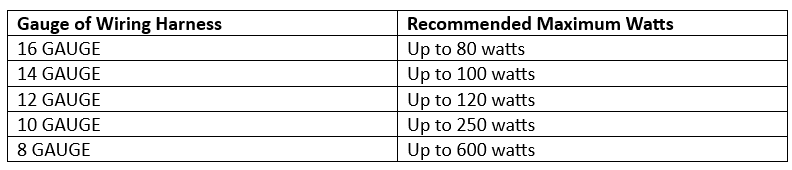
Another factor to consider is whether you have the proper gauge wiring in place to handle the increase in output required for the amp. If your wiring is not built to handle this kind of output, it could mean a little upgrading is in order. On the other hand, if your wiring harness is old, it could mean a complete overhaul depending on the age and gauge of wiring used.
Antenna
Your antenna system also needs to be sufficient to handle the increased output. If the co-ax isn’t a large enough gauge, your antenna system may overheat and cause damage because of the ramped-up output.
Most antennas are rated to handle between 800 - 1500 watts PEP.
RG-8X co-ax is rated for up to 1500 watts PEP and is sufficient for most antenna systems; albeit there are times when higher-quality co-ax is required.
Compatibility
Not all amps are created equal, and neither are all radios. It is important to ensure that your equipment is compatible with one another.
Average amplifiers have an input dead key wattage, generally between 1-4 watts depending on the amp. An amplifier should have a PEP output of 3.5 – 4 times the PEP output of the transmitting unit. Although, there are times when 2.5 times more PEP output than the transmitting unit is sufficient. But those situations are generally a unit that has up to 40 watts PEP.
Another thing to remember is that higher power output also means a higher risk of interference. Setting SWR’s for the desired frequency of operation is required for the most efficient transmission.
Durability
Take care that whatever amp you choose to add to your lineup is right for the setup. Some radios are simply built to make it on bumpy roads and others sputter and die too fast to last.
